
Introduction
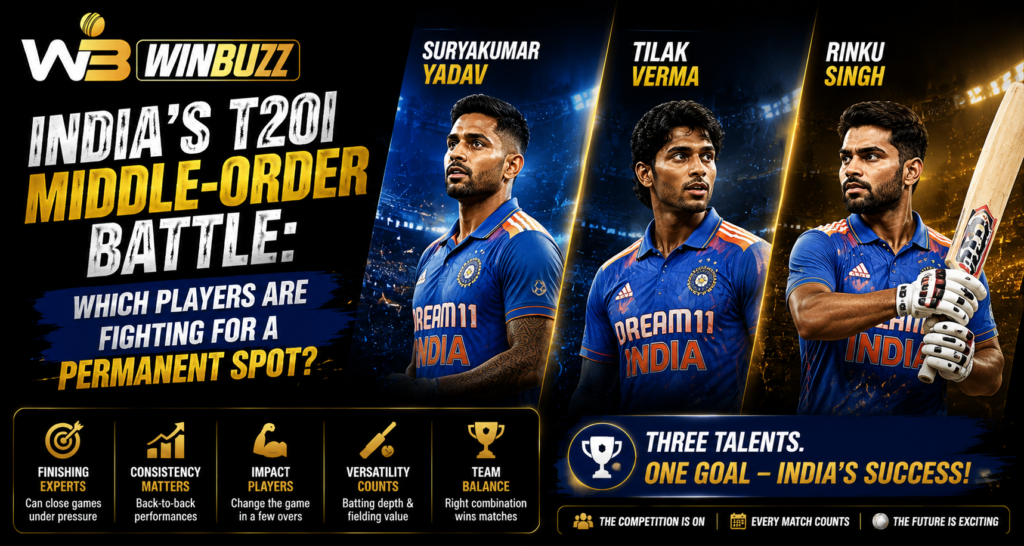
India’s T20I team has entered a new phase where competition for middle-order positions has become stronger than ever. With several talented batters available, selectors face the challenge of finding the right combination before major tournaments. For Winbuzz followers tracking India’s cricket updates, the battle for permanent middle-order spots has become one of the most interesting selection stories.
Why India’s Middle Order Needs Stability
The middle order plays a crucial role in T20 cricket because matches often change direction during the middle and final overs.
A strong middle order provides:
- Quick scoring ability
- Pressure handling
- Finishing skills
- Partnership building
- Flexibility against different bowling attacks
India have several options, but selecting the right combination remains a major challenge.
The Role of a T20 Middle-Order Batter
A successful middle-order batter needs more than just power hitting.
Important qualities include:
- Ability to rotate strike
- Confidence against spin bowling
- Boundary-scoring ability
- Match awareness
- Finishing skills
Modern T20 cricket demands players who can adapt quickly according to match situations.
Suryakumar Yadav’s Importance
Suryakumar Yadav remains one of India’s most important T20 batters because of his ability to change games quickly.
His strengths include:
- Innovative shot selection
- Strong against pace and spin
- Experience in pressure situations
- Ability to accelerate innings
His presence provides stability in the middle overs.
Rinku Singh’s Finishing Role
Rinku Singh has built a reputation as a reliable finisher for India.
His key qualities include:
- Powerful hitting
- Calmness under pressure
- Ability to handle final overs
- Strong boundary options
His role becomes especially important when India need quick runs at the end of an innings.
Tilak Varma’s Growing Opportunity
Tilak Varma has emerged as another strong contender for a regular middle-order position.
His advantages include:
- Left-hand batting option
- Ability to play spin well
- Consistent domestic performances
- Flexibility in batting positions
A left-right combination can provide India with additional tactical options.
Other Players in the Competition
India’s T20I squad depth means several players are competing for limited positions.
Potential contenders include:
- Shivam Dube
- Sanju Samson
- Jitesh Sharma
- Other emerging batters
Each player brings different strengths depending on match conditions.
Selection Challenges for India
The biggest challenge for selectors is creating balance.
Important questions include:
- Should India prefer power hitters?
- Is a specialist finisher needed?
- How many all-rounders should play?
- Should the team focus on left-right combinations?
These decisions become important before major T20 tournaments.
Importance of Player Form
T20 cricket rewards players who are performing consistently.
Selectors usually consider:
- Recent international performances
- Domestic form
- Fitness levels
- Role suitability
- Performance under pressure
A player’s ability to perform a specific role often matters more than reputation.
How Conditions Can Influence Selection
Different venues require different team combinations.
For example:
- Slow pitches may favour spin players
- Flat pitches may require more power hitters
- Bigger grounds may reward strike rotation
India’s middle-order choices may change depending on conditions.
Future of India’s T20 Batting Lineup
India have a strong pool of young batters who can compete for places over the next few years.
For fans checking Winbuzz login updates, tracking these selection battles provides insight into how India are building their next generation of T20 players.
Conclusion
India’s T20I middle-order battle highlights the strength of their batting depth. Players like Suryakumar Yadav, Rinku Singh, Tilak Varma, and other contenders are fighting for limited positions, making selection decisions more competitive.
For Winbuzz live cricket followers, the upcoming matches will reveal which players can consistently deliver under pressure and secure a long-term place in India’s T20 setup.
FAQs
Why is India’s T20I middle order important?
The middle order controls the momentum of innings and handles pressure situations during crucial phases.
Who are the main contenders for India’s T20 middle-order spots?
Players like Suryakumar Yadav, Rinku Singh, Tilak Varma, and other emerging batters are competing for places.
What qualities does a T20 middle-order batter need?
Power hitting, strike rotation, pressure handling, and adaptability are important skills.
Does player form affect T20I selection?
Yes. Recent performances, fitness, and role suitability are important selection factors.
Can India change their middle-order combination regularly?
Yes. Team combinations often change depending on opponents, conditions, and tournament requirements.