
Introduction
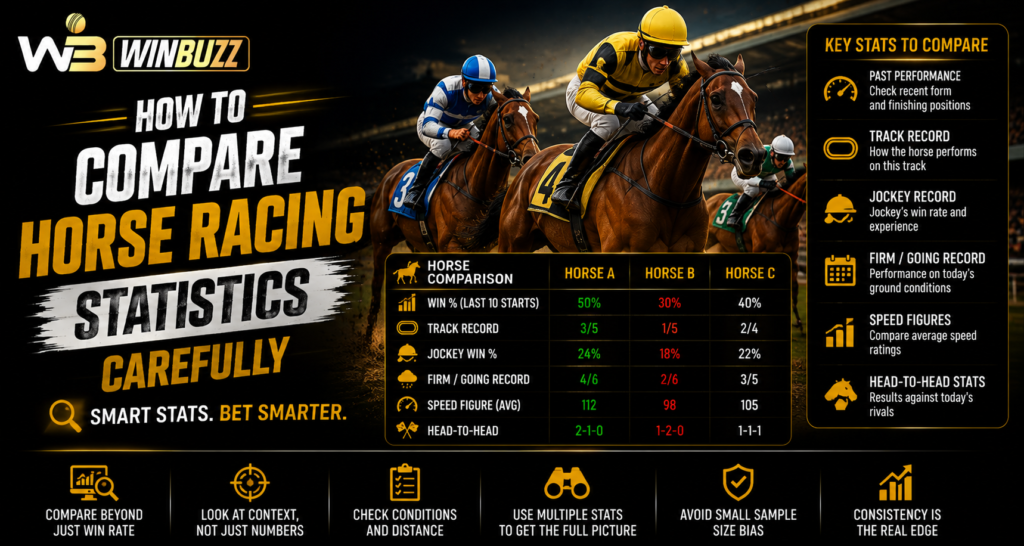
Horse racing statistics can provide useful information when analysing a race, but numbers alone do not tell the complete story. Every race involves different conditions, including track surface, distance, competition level, weather and horse fitness. For Winbuzz users exploring horse racing information, learning how to read statistics carefully can help create a clearer understanding of performance trends instead of relying on a single number.
Why Horse Racing Statistics Matter
Statistics help organise information about a horse’s previous performances. They can show patterns that may not be obvious when looking only at recent results.
Important statistics often include:
- Recent finishing positions
- Race distance history
- Track performance
- Speed ratings
- Trainer record
- Jockey performance
- Weight carried
- Competition quality
However, each statistic needs context before drawing conclusions.
1. Look at Recent Form
A horse’s recent form is one of the first areas many people review.
Recent races can show:
- Whether the horse is improving
- Whether performance is declining
- How consistently it finishes
- Whether it performs well under similar conditions
However, the finishing position alone may not explain the full performance.
A horse finishing fourth in a strong race may have performed better than a horse winning against weaker competition.
2. Compare Similar Race Conditions
One of the most important factors in horse racing analysis is comparing similar conditions.
Consider:
- Same distance
- Same track type
- Similar surface
- Similar competition level
- Similar weather conditions
A horse that performs well on a short-distance race may not produce the same results over a longer distance.
Past success is more meaningful when the conditions closely match the upcoming race.
3. Understand Speed Ratings
Speed figures attempt to measure how quickly a horse performed compared with other races.
They can help compare horses from different events, but they should not be viewed separately.
Speed ratings can be influenced by:
- Track condition
- Race pace
- Weight carried
- Quality of opponents
- Timing methods
A higher rating does not always guarantee future success.
4. Evaluate Track Performance
Some horses perform better at specific venues.
Track statistics can reveal whether a horse is comfortable with:
- A particular course layout
- Surface type
- Turns
- Straight sections
- Local conditions
A horse with strong previous results at the same track may have an advantage, but recent fitness and competition level still matter.
5. Consider Jockey and Trainer Records
The people involved can influence race outcomes.
A jockey’s experience with a particular horse or track may be valuable, while a trainer’s record can provide information about preparation and consistency.
Useful areas to compare include:
- Win percentage
- Recent results
- Experience with similar races
- Performance with specific horses
These statistics should support analysis rather than become the only deciding factor.
6. Check Weight and Handicap Information
Weight can affect a horse’s performance, especially over longer distances.
A horse carrying additional weight may face a different challenge compared with previous races.
When comparing statistics, check:
- Previous carried weight
- Current assigned weight
- Handicap adjustments
- Distance involved
Small differences can become important depending on the race conditions.
7. Analyse Competition Quality
Not all victories have the same value.
A horse winning against experienced competitors in a high-level race may have produced a stronger performance than a horse winning an easier event.
Look at:
- Previous opponents
- Race classification
- Field strength
- Performance against similar horses
Context matters more than the result alone.
8. Avoid Relying on One Statistic
A common mistake is focusing on only one number.
For example:
- A high speed rating may ignore poor track performance.
- A strong win record may come against weaker opponents.
- A recent victory may not reflect current conditions.
A balanced approach combines multiple factors.
How to Use Horse Racing Data Responsibly
When reviewing horse racing information, users should focus on understanding trends rather than assuming statistics can predict every result.
Useful habits include:
- Comparing multiple races
- Checking official information
- Understanding limitations of statistics
- Avoiding emotional decisions
- Setting personal limits
Those accessing Winbuzz live sports information should remember that racing outcomes involve uncertainty and unpredictable events.
Conclusion
Comparing horse racing statistics requires more than checking wins, losses or rankings. Track conditions, distance, competition level, jockey performance, trainer records and horse fitness all influence how meaningful a statistic really is.
A careful approach looks at the complete picture instead of relying on one performance number. Understanding the context behind statistics creates a more informed way to follow horse racing events.
FAQs
Which horse racing statistics are most important?
Recent form, track record, distance performance, speed ratings, trainer results and jockey records are commonly reviewed.
Is a horse with the most wins always the best choice?
No. Wins should be considered alongside competition quality, race conditions and recent performance.
Why does race distance matter?
Horses may perform differently at different distances because of stamina, pace and running style.
Are speed ratings always accurate?
Speed ratings are useful comparison tools, but they should be considered with track conditions and race context.
Can statistics guarantee a race result?
No. Statistics can provide information about past performance, but horse racing always includes uncertainty.